The Evolution of Operational Art - Bruce W. Menning
104,55 lei
+4,18 lei înapoiSuma de cashback este aproximativă. Suma finală va fi vizibilă la finalizarea achiziției pe site-ul vânzătorului.Preț stabilneschimbat din 30 sept.
30 sept.azi
Descriere
nOne can argue that the development of true doctrine required the formal adoption of the concept of operational art. Prior to the Great War, no army in the world possessed a codified body of thought that enabled senior military commanders to visualize the aggregate effects of tactical engagements across time and space. By 1918, after a dramatic revision of drill regulations into something approaching true doctrine, the German army was furthest in realizing this goal.
Ultimately, though, the Germans could not translate tactical success into strategic victory because they could not resource military operations in sufficient depth to render local successes decisive. Understanding that the character of warfare in 1918 was radically different from 1914 would have enabled Ludendorff to see the flaws in the MICHAEL offensives and perhaps mitigate them. And although the interwar German Army spent a great deal of effort reflecting on the lessons of 1914-1918, German understanding of the operational art remained incomplete.
The separate and unequal Allied efforts against Nazi Germany in World War II, followed immediately by the superpower competition of the Cold War, created a significant gap in American officers' understand- ing of the factors that contributed to Soviet victories on the Eastern Front. As a result, in the decades following the war the concept of operational art was recognized and adopted by the US Army almost as a proprietary creation. In the 1990s, however, Western military historians and theorists discovered that the Soviets had gotten there first.
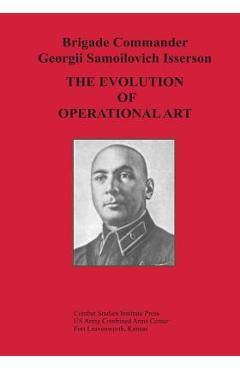
Bruce Menning's translation of Georgii Samoilovich Isserson's 1936 treatise The Evolution of Operational Art is the best example available of the distillation of Soviet military thought before the Second World War. Isserson, Tukhachevsky, Shaposhnikov, and others like them were founding members of a focused military Enlightenment whose goal was to change the way armies and leaders thought about war. Moreover, unlike contemporaries such as B.H.
Liddell Hart or Billy Mitchell, they had the opportunity to build their ideas into the modem Soviet Army and see their doctrine survive despite the existential challenges of Stalin's purges and the German invasion.
Caracteristici
Cum primești cashback-ul
Cumperi prin YolozApeși „Cumpără” și finalizezi comanda pe LIBRIS.
Confirmat în ~45 de zileDupă ce trece perioada de retur a magazinului.
 LIBRIS4% înapoi
The Evolution of Operational Art - Bruce W. Menning
104,55 lei
+4,18 lei înapoiSuma de cashback este aproximativă. Suma finală va fi vizibilă la finalizarea achiziției pe site-ul vânzătorului.Preț stabilneschimbat din 30 sept.
30 sept.azi
104,55 lei+4,18 lei înapoi
Descriere
nOne can argue that the development of true doctrine required the formal adoption of the concept of operational art. Prior to the Great War, no army in the world possessed a codified body of thought that enabled senior military commanders to visualize the aggregate effects of tactical engagements across time and space. By 1918, after a dramatic revision of drill regulations into something approaching true doctrine, the German army was furthest in realizing this goal.
Ultimately, though, the Germans could not translate tactical success into strategic victory because they could not resource military operations in sufficient depth to render local successes decisive. Understanding that the character of warfare in 1918 was radically different from 1914 would have enabled Ludendorff to see the flaws in the MICHAEL offensives and perhaps mitigate them. And although the interwar German Army spent a great deal of effort reflecting on the lessons of 1914-1918, German understanding of the operational art remained incomplete.
The separate and unequal Allied efforts against Nazi Germany in World War II, followed immediately by the superpower competition of the Cold War, created a significant gap in American officers' understand- ing of the factors that contributed to Soviet victories on the Eastern Front. As a result, in the decades following the war the concept of operational art was recognized and adopted by the US Army almost as a proprietary creation. In the 1990s, however, Western military historians and theorists discovered that the Soviets had gotten there first.
Bruce Menning's translation of Georgii Samoilovich Isserson's 1936 treatise The Evolution of Operational Art is the best example available of the distillation of Soviet military thought before the Second World War. Isserson, Tukhachevsky, Shaposhnikov, and others like them were founding members of a focused military Enlightenment whose goal was to change the way armies and leaders thought about war. Moreover, unlike contemporaries such as B.H.
Liddell Hart or Billy Mitchell, they had the opportunity to build their ideas into the modem Soviet Army and see their doctrine survive despite the existential challenges of Stalin's purges and the German invasion.