///
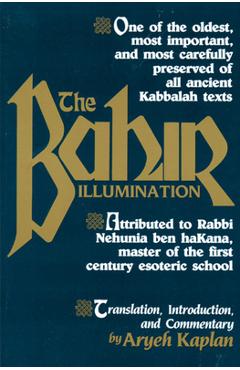
The Bahir - Aryeh Kaplan
155,46 lei172,73 lei−10%
6,22 lei înapoi în contul Yoloz
n nThe Bahir is one of the oldest and most influential of all classical Kabbalah texts. n nUntil the publication of the Zohar, the Bahir was the most widely quoted primary source of Kabbalistic teachings. The Bahir is quoted in every major book on Kabbalah, the earliest being the Raavad's commentary on Sefer Yetzirah, and it is cited numerous times by Rabbi Moshe ben Nachman (Ramban) in his commentary on the Torah. It is also quoted many times in the Zohar. It was first published around 1176 by the Provence school of Kabbalists; the first printed edition appeared in Amsterdam in 1651. The name Bahir is derived from the first verse quoted in the text (Job 37:21), And now they do not see light, it is brilliant (Bahir) in the skies. It is also called the Midrash of Rabbi Nehuniah ben HaKana, particularly by the Ramban. The reason might be that Rabbi Nehuniah's name is at the very beginning of the book, but most Kabbalists actually attribute the Bahir to him and his school. Some consider it the oldest kabbalistic text ever written. n nAlthough the Bahir is a fairly small book, some 12,000 words in all, it was very highly esteemed among those who probed its mysteries. Rabbi Judah Chayit, a prominent fifteenth-century Kabbalist, writes, Make this book a crown for your head. Much of the text is very difficult to understand, and Rabbi Moshe Cordevero (1522-1570), head of the Safed school of Kabbalah, says, The words of this text are bright (Bahir) and sparkling, but their brilliance can blind the eye. One of the most important concepts revealed in the Bahir is that of the Ten Sefirot, and careful analysis of these discussions yields much of what will be found in later kabbalistic works, as well as their relation to anthropomorphism and the reason for the commandments. Also included is a discussion of reincarnation, or Gilgul, an interpretation of the letters of the Hebrew alphabet, the Thirty-two Paths of Wisdom, and the concept of Tzimtzum. n n
Cum primești cashback-ul
Cumperi prin YolozApeși „Cumpără” și finalizezi comanda pe LIBRIS.
Confirmat în ~45 de zileDupă ce trece perioada de retur a magazinului.
155,46 lei+6,22 lei cashback
The Bahir - Aryeh Kaplan
n nThe Bahir is one of the oldest and most influential of all classical Kabbalah texts. n nUntil the publication of the Zohar, the Bahir was the most widely quoted primary source of Kabbalistic teachings. The Bahir is quoted in every…
Cea Mai Bună Ofertă
Preț avantajos verificat
În Stoc

LIBRIS
172,73 lei-10% Reducere
155.46lei
6,22 lei cashback
Promoții LIBRIS
Cea Mai Bună Ofertă
Preț avantajos verificat
În Stoc
LIBRIS
172,73 lei-10% Reducere
155.46lei
6,22 lei cashback
Promoții LIBRIS
Istoric Prețuri
Preț stabil
Acum 155,46 lei la LIBRIS. Prețul nu s-a schimbat în ultimele 30 de zile.
Prețul la LIBRIS în ultimele 30 de zile
Prețul tăiat de magazin
172,73 lei
mai mare decât orice preț în ultimele 30 de zile
- Brand
- Aryeh Kaplan
- Categorie
- Religion