///
Physics for Entertainment - Yakov Perelman
113,00 lei125,55 lei−10%
4,52 lei înapoi în contul Yoloz
nPublished in 1913, a best-seller in the 1930s and long out of print, Physics for Entertainment was translated from Russian into many languages and influenced science students around the world. Among them was Grigori Yakovlevich Perelman, the Russian mathematician (unrelated to the author), who solved the Poincar conjecture, and who was awarded and rejected the Fields Medal. Grigori's father, an electrical engineer, gave him Physics for Entertainment to encourage his son's interest in mathematics. In the foreword, the book's author describes the contents as conundrums, brain-teasers, entertaining anecdotes, and unexpected comparisons, adding, I have quoted extensively from Jules Verne, H. G. Wells, Mark Twain and other writers, because, besides providing entertainment, the fantastic experiments these writers describe may well serve as instructive illustrations at physics classes. The book's topics included how to jump from a moving car, and why, according to the law of buoyancy, we would never drown in the Dead Sea. Ideas from this book are still used by science teachers today.
Cum primești cashback-ul
Cumperi prin YolozApeși „Cumpără” și finalizezi comanda pe LIBRIS.
Confirmat în ~45 de zileDupă ce trece perioada de retur a magazinului.
113,00 lei+4,52 lei cashback
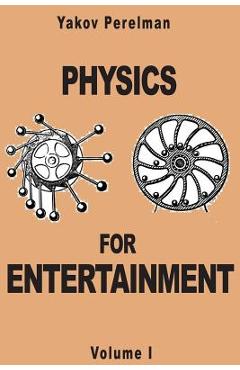
Physics for Entertainment - Yakov Perelman
nPublished in 1913, a best-seller in the 1930s and long out of print, Physics for Entertainment was translated from Russian into many languages and influenced science students around the world. Among them was Grigori Yakovlevich Perelman,…
Cea Mai Bună Ofertă
Preț avantajos verificat
În Stoc

LIBRIS
125,55 lei-10% Reducere
113.00lei
4,52 lei cashback
Promoții LIBRIS
Cea Mai Bună Ofertă
Preț avantajos verificat
În Stoc
LIBRIS
125,55 lei-10% Reducere
113.00lei
4,52 lei cashback
Promoții LIBRIS
Istoric Prețuri
Preț stabil
Acum 113 lei la LIBRIS. Prețul nu s-a schimbat în ultimele 30 de zile.
Prețul la LIBRIS în ultimele 30 de zile
Prețul tăiat de magazin
125,55 lei
mai mare decât orice preț în ultimele 30 de zile
- Brand
- Yakov Perelman
- Categorie
- Science